
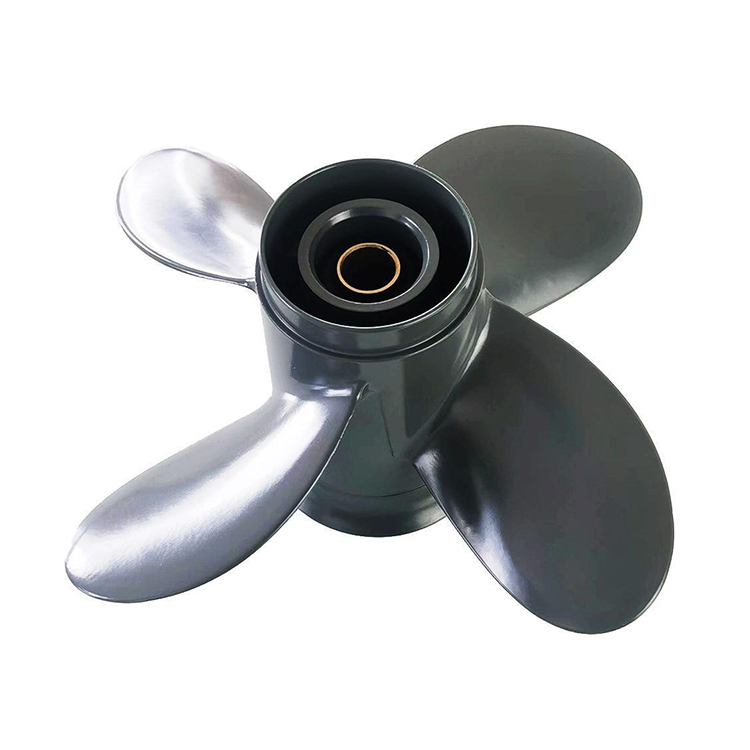
Most days on the water start at the ramp, and an Aluminum Outboard Boat Propeller is part of the routine in ways owners may not notice until a change is needed. It is light enough to handle without much effort, generally costs less than a stainless steel alternative, and affects how a small outboard accelerates and carries a load. From launching the boat to choosing a propeller for different trips, weight and pitch help explain why aluminum remains a practical option for many recreational boats.
Aluminum has roughly one third the density of stainless steel, so a cast propeller of similar dimensions is generally lighter to handle. That difference is useful before the boat leaves the ramp. A lighter prop is easier to carry down a dock, hold in position while fitting the nut, and replace when a spare is needed.
Weight also affects the rotating assembly. For smaller outboards, a relatively light propeller can contribute to responsive acceleration, although engine power, propeller diameter and pitch, hull shape and boat load all influence the result. For an owner running a compact hull with a modest outboard, an Aluminum Outboard Boat Propeller can provide a practical balance of handling, cost and everyday performance without changing the engine.
Zinntu's propeller category includes several aluminum models, an aluminum marine outboard propeller, a 3 Blade Marine Aluminum Propeller, and a stainless steel option. As an Outboard Propeller Factory, Zinntu lists these options within its propeller range for different boat and engine requirements. Its product information identifies marine-grade aluminum and stainless steel options.
Pitch describes the theoretical distance a propeller would move forward in one revolution. In practical use, it influences engine RPM, acceleration and the boat's ability to get onto plane. A boat carrying two people, fuel and fishing gear sits differently in the water from the same hull running with one person and little equipment. A lower-pitch propeller can help a heavily loaded boat reach planing speed while keeping the engine within its recommended operating range. A higher pitch may suit a lighter load when the engine can still reach its recommended RPM range.
A common rule of thumb estimates a change of roughly 150 to 200 RPM for each inch of pitch, although the actual result varies with the engine, hull and propeller. The useful check is the engine speed at wide-open throttle compared with the manufacturer's recommended range. An Aluminum Outboard Boat Propeller with a suitable pitch helps keep that operating point within the intended range. Choosing an Aluminum Outboard Boat Propeller should therefore start with the engine's recommended RPM range, not just the boat's expected top speed. Propellers are often available in one-inch pitch steps, making a one-step change a manageable way to fine-tune a boat's response. Owners can then compare acceleration, planing time and engine RPM under similar load conditions.
Because aluminum propellers generally cost less than stainless steel models, some owners keep a spare with a different pitch. One may suit spring fishing trips with a full load of gear, while another may work better for summer outings with fewer passengers. Swapping an Aluminum Outboard Boat Propeller is a relatively straightforward maintenance task when the correct tools and replacement hardware are available. It can change how the same boat performs without requiring a different engine. A second Aluminum Outboard Boat Propeller also gives owners a practical option when trip conditions change.
For boat brands and dealers, offering several pitch options can make product selection more practical. A range of Aluminum Outboard Boat Propeller models gives customers choices for different hull and engine combinations, while allowing distributors to stock related parts within one product family. Zinntu's product information also refers to multiple blade configurations and sizes that can be customized for specific vehicles or machinery. The appropriate combination should still be confirmed against the engine manufacturer's recommendations and the boat's operating requirements. An Outboard Propeller Factory supplying these configurations needs to account for the intended engine and hull pairing when preparing an order.
Three-blade propellers are commonly used on recreational runabouts, small fishing boats and light utility craft. A 3 Blade Marine Aluminum Propeller is one configuration within this category, while the final choice depends on diameter, pitch, engine compatibility and expected load. Dealers can use these factors to explain why two boats with similar engines may require different propeller specifications. A well-matched Aluminum Outboard Boat Propeller gives the owner a way to adjust the boat's behavior through propeller selection rather than accepting an unsuitable pitch.

 Building 1 and 2, No. 2269, Jingzhong Road, Hongjia Street, Taizhou, Zhejiang, China
 +86-18857621312
 info@zinntu.com


 English
 русский
 عربى

