
As unmanned equipment, inspection robots, agricultural carriers, and special-purpose vehicles continue to appear in more working environments, the rubber track chassis has become a common mobility platform. Compared with wheel-based designs, a rubber track chassis can move across soft ground, uneven terrain, and outdoor work areas with greater stability. However, selecting a chassis is rarely as simple as comparing dimensions or speed figures. Different projects often place very different demands on the undercarriage.
Before comparing models, it is worth looking at the ground conditions the machine will face every day. Different terrains place different demands on a rubber track chassis.
For example:
A rubber track chassis designed for agricultural work may not be the right choice for industrial inspection, even if the external size appears similar.
Many buyers pay attention to travel speed when reviewing specifications. In reality, carrying capacity often has a greater impact on day-to-day operation. Every rubber track chassis is designed around a certain weight range that includes equipment, batteries, sensors, and any additional payload.
When operating weight rises beyond the intended range, wear on the tracks and drive system may increase more quickly. A practical approach is to estimate the actual working weight and leave some room for future equipment additions rather than selecting a chassis that constantly operates near its rated capacity.
Track width affects how the machine interacts with the ground. Wider tracks spread weight over a larger area, while narrower tracks can make movement easier in restricted spaces.
When evaluating a rubber track chassis, buyers often compare:
There is rarely a track width that suits every project. What works well in a greenhouse may not be the preferred option on a rocky construction site.
The drive system determines how power reaches the tracks. In many cases, the performance of a rubber track chassis is influenced just as much by the drive configuration as by the tracks themselves.
Some models are designed for controlled low-speed movement, while others focus on covering greater distances. Torque output, climbing ability, steering behavior, and terrain adaptability all depend on how the motor and transmission work together.
For unmanned systems, smooth control is often valued more than raw speed.
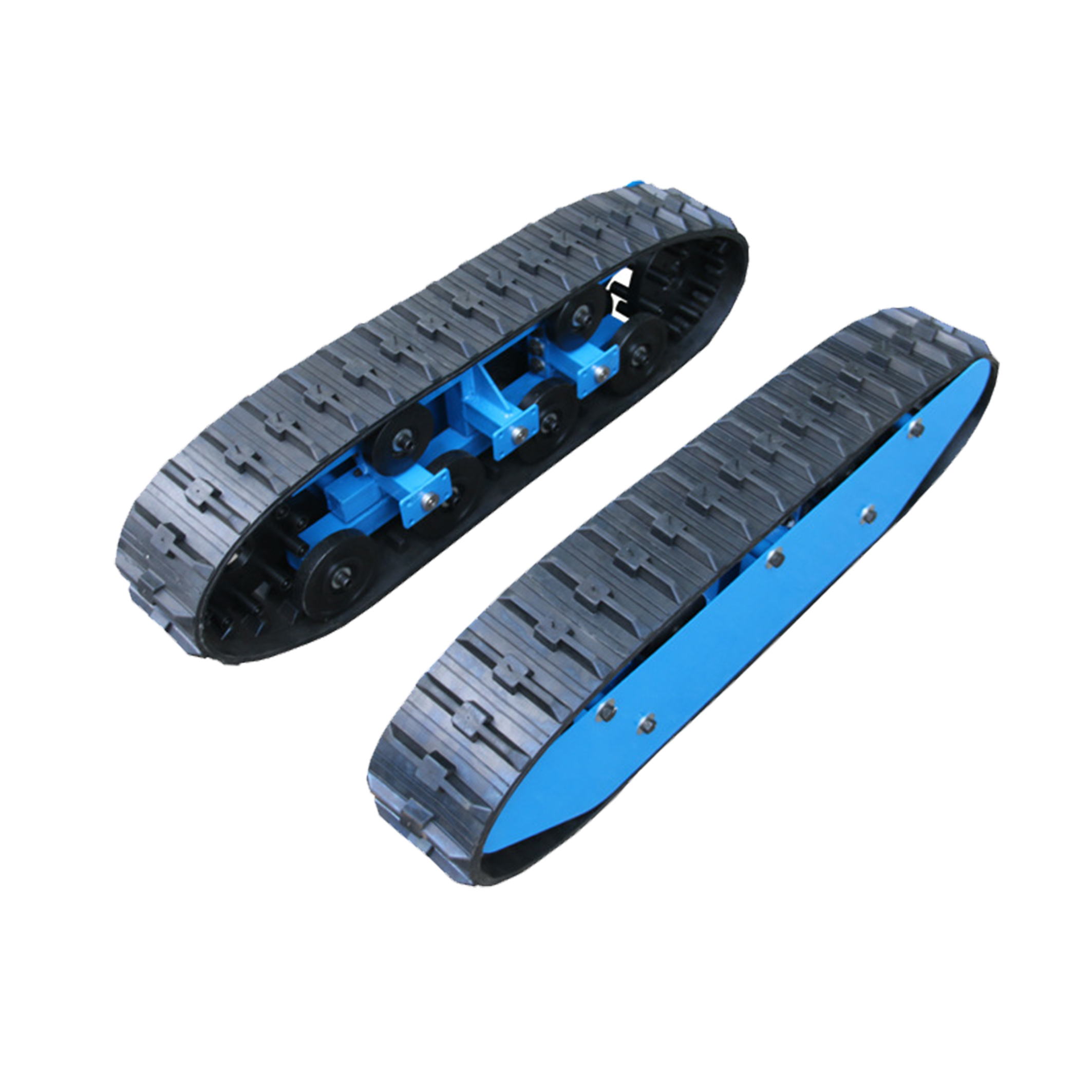
A rubber track chassis rarely operates on perfectly smooth surfaces. Small obstacles, ruts, loose stones, and uneven ground create continuous vibration during operation.
Suspension systems help absorb part of that movement and improve platform stability. This becomes especially important when cameras, sensors, inspection devices, or other precision equipment are mounted on the vehicle.
Without proper shock absorption, vibration may affect both equipment performance and long-term component wear.
Different chassis designs come with different maintenance expectations. Some focus on easier servicing, while others prioritize compact construction.
Before selecting a rubber track chassis, buyers often evaluate:
These factors may not attract attention during the purchasing stage, but they often become important after the equipment enters regular service.
A rubber track chassis is rarely the final product by itself. In many projects, it acts as the foundation for another system.
Agricultural robots, transport platforms, inspection vehicles, and remote-controlled equipment may all use a rubber track chassis, yet their priorities are often different.
For example, an agricultural platform may focus on traction and flotation, while an inspection vehicle may place greater emphasis on smooth movement and steering precision.
It is common to compare length, width, and height when reviewing product specifications. Those numbers are useful, but they do not tell the whole story.
A rubber track chassis with dimensions similar to another model may perform very differently because of changes in motor configuration, suspension design, track construction, or weight distribution.
This is why experienced buyers often start with the application itself rather than the specification sheet.
Choosing a rubber track chassis is ultimately about matching the platform to the work it will perform. Terrain, payload, drive configuration, maintenance planning, and mounted equipment all influence the decision.
Many purchasing decisions eventually come back to a simple question: what will the machine actually do each day? Once that answer is clear, the suitable rubber track chassis is usually much easier to identify. A model that performs well in real working conditions is often a better fit than one chosen purely from specification comparisons.


 Building 1 and 2, No. 2269, Jingzhong Road, Hongjia Street, Taizhou, Zhejiang, China
  +86-18857621312
  info@zinntu.com

 English
 русский
 عربى
عربى
