
An unmanned tracked transport platform has to do more than move from one location to another. It must carry its intended load while maintaining stable movement, sufficient ground contact, and compatibility between the running gear and the upper structure. For equipment manufacturers sourcing a Track Tracked Trolley, load distribution is therefore an important consideration before a platform enters assembly or field testing.
The same chassis may behave differently when carrying a flat cargo deck, an equipment enclosure, a battery pack, or a raised working unit. These components change the total mass and where that mass acts on the vehicle. Evaluating the complete load arrangement helps manufacturers establish a suitable platform configuration for the intended application.
Payload weight is only one part of the assessment. Its position relative to the track contact area also affects how the vehicle behaves during movement. A load concentrated toward the front can increase pressure around the front section of the running gear, while a rear-heavy arrangement may shift more load toward the opposite end.
For a Track Tracked Trolley, engineers need to consider both the total payload and its distribution. Equipment mounted above the chassis can also raise the center of gravity. When the vehicle travels across uneven ground, turns, or moves along a slope, this height may influence stability.
These factors are relevant to unmanned ground vehicles used for equipment transport, inspection tasks, and other industrial operations. Before confirming a chassis for production, manufacturers should evaluate the intended payload position alongside the vehicle's overall weight and operating conditions.
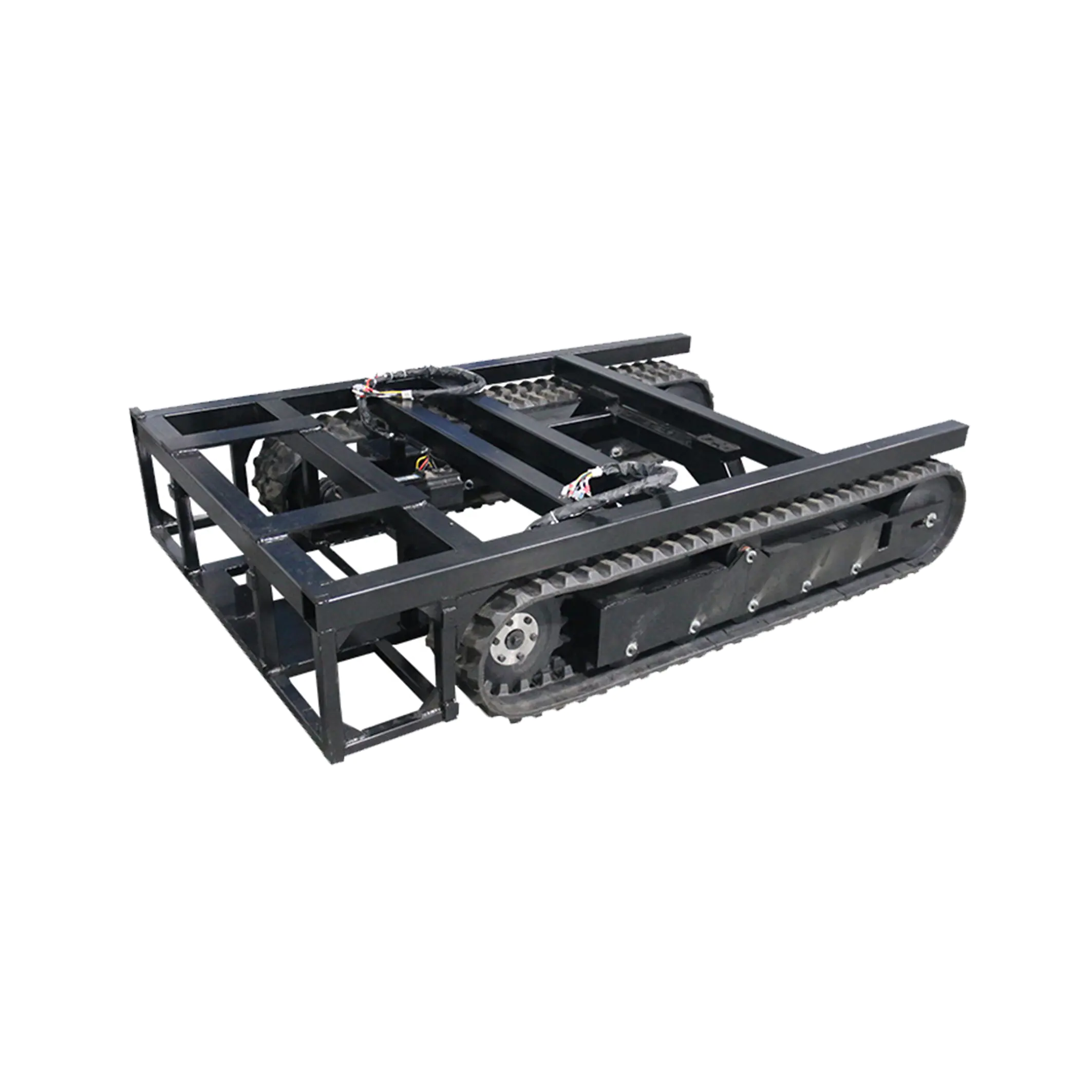
The chassis and its upper structure should be treated as connected parts of one vehicle system. A mounting deck, protective enclosure, control unit, or battery compartment occupies space and adds weight. Each component also needs an appropriate attachment arrangement.
When integrating a Track Tracked Trolley, equipment manufacturers should confirm the available mounting area, fixing positions, overall dimensions, and clearance around moving components. These details help determine whether the planned upper structure can be installed without interfering with the tracks or other chassis parts.
Packaging also affects maintenance access. If routine inspection points or electrical connections become difficult to reach after an enclosure is installed, later servicing may require additional disassembly. Reviewing access requirements during integration can reduce avoidable changes after the first assembled unit is completed.
A tracked platform moves through the interaction between its tracks and the ground. During a turn, the tracks work at different speeds or in opposing directions, depending on the drive system. The resulting movement places different demands on the vehicle than straight-line travel.
For this reason, a Track Tracked Trolley intended for a particular task should be assessed under conditions that reflect its expected operation. A platform carrying a compact, centrally positioned load may behave differently from one carrying a tall enclosure or equipment mounted close to one side.
Ground conditions also matter. Loose soil, gravel, hard floors, and uneven outdoor surfaces can produce different levels of resistance and track contact. Manufacturers should consider these conditions alongside payload distribution rather than evaluating vehicle movement from unloaded operation alone.
For B2B buyers and equipment integrators, clear project information helps align the selected platform with the finished vehicle. The following details provide a practical starting point for technical discussion.
|
Project information |
Why it matters |
|
Total vehicle and payload weight |
Establishes the expected overall loading |
|
Payload position and height |
Helps assess load distribution and stability |
|
Upper structure dimensions |
Supports checks for mounting space and clearance |
|
Intended ground conditions |
Clarifies the operating environment |
|
Required mounting points |
Helps coordinate the chassis with attached equipment |
|
Electrical and control requirements |
Identifies integration needs for powered or remotely operated systems |
For a Track Tracked Trolley, these details should be reviewed before buyers finalize the chassis configuration. Drawings, mounting information, and representative payload details can help both parties identify interface requirements before production quantities are confirmed.
Sample testing is more useful when the test configuration resembles the intended production unit. Evaluating an unloaded chassis alone cannot fully represent the effect of the finished upper structure, battery, or working equipment. Where practical, the sample should be assessed with a representative load and mounting arrangement.
The same principle applies when a project moves from sample approval to batch production. Changes to payload weight, component placement, or enclosure dimensions can affect the original assessment. A Track Tracked Trolley specification should therefore remain aligned with the approved configuration, and revisions should be communicated before manufacturing proceeds.
For manufacturers developing unmanned transport equipment, this coordination connects chassis sourcing with the wider vehicle assembly process. Clear load information, defined mounting interfaces, and consistent sample configurations give procurement and engineering teams a common basis for reviewing the platform before scaling up orders.




 Building 1 and 2, No. 2269, Jingzhong Road, Hongjia Street, Taizhou, Zhejiang, China
 +86-18857621312
 info@zinntu.com


 English
 русский
 عربى

